
The SMEs that won the cloud transition weren’t the first movers. They sequenced their workloads by risk, and the same order works for AI.
In our first two posts, we revisited the 2010 board meeting and the shadow IT that ran ahead of it. Here we look at what the winners did next.
The SMEs that came out of the cloud transition ahead were rarely the first movers. They moved in order. Gartner placed cloud computing at the peak of its Hype Cycle in 2009 and expected mainstream adoption within two to five years. The firms that did well used those years to sequence their workloads instead of racing.
Email, file sharing and CRM went first, because a mistake there was cheap and easy to spot. Finance and core operations waited until the cloud had proven itself, and some never moved at all.
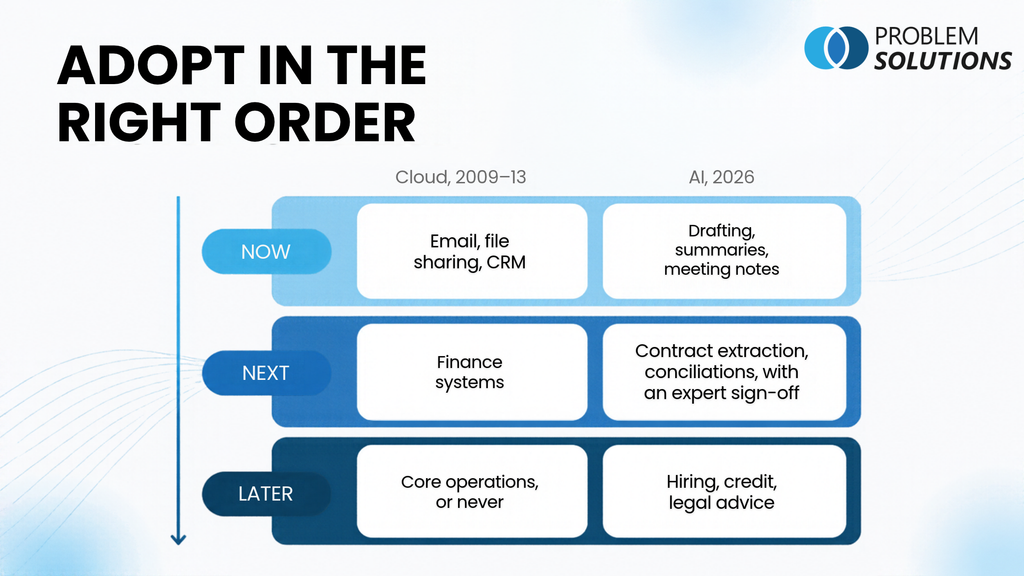
AI rewards the same sequence, with one adjustment. Cloud risk turned on where data lived. AI risk also turns on whether anyone can catch the model’s mistakes. Two questions sort any task: what does an error cost, and how easily can a person spot it?
- Now: drafting, summaries, meeting notes and translation. Errors are cheap and visible.
- Next, with an expert signing off: contract data extraction, invoice reconciliation, and client replies in regulated fields. Errors are costly but checkable.
- Later: hiring, credit and legal advice, and agents acting alone on live systems. These wait until your controls catch up with your ambitions.
The firms that sorted their workloads before buying anything spent less and regretted less.
The Second Migration includes the full workload-by-risk matrix, a buying stance for a market where open models cap prices, and five moves for the next 12 months.
Read the full paper:
The Second Migration – What the Cloud Years Teach SME Leaders about AI


