
Cloud governance asked where your data lived.80% of executives say AI improves productivity, but only 37% see it in EBIT. Here’s how SMEs can turn time saved into results the CFO will recognize.
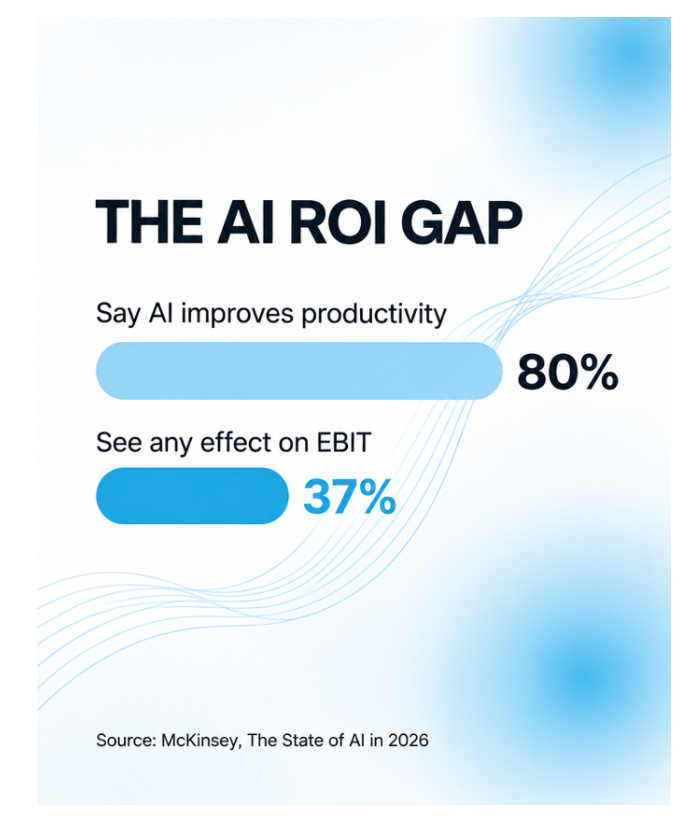
Ask almost any team whether AI helps, and the answer is yes. McKinsey’s State of AI survey, published in August 2026, found that 80% of respondents say AI improves individual productivity, and nearly nine in ten work at organizations that use it.
Ask the finance team, and the picture changes. Only 37% of respondents report any effect on EBIT, and about 6% attribute 5% or more of EBIT to AI.
Forrester saw the correction coming. In its 2026 predictions, it expected enterprises to defer a quarter of planned AI spending into 2027, because fewer than a third of decision-makers could tie AI to financial growth. It also predicted that CEOs would lean on CFOs to approve AI investments based on ROI.
Time saved on drafting or summaries is real, but it reaches the P&L only when someone redeploys the hours or stops paying for something. The cloud years taught the same lesson. In a 2012 Microsoft-sponsored survey, 41% of cloud-using SMBs said they had moved staff into roles that drive growth. Their returns showed up in that reallocation.
These numbers make the case for discipline. Give every AI pilot three things:
- An owner accountable for results, not only for the rollout.
- A baseline metric, measured before AI touches the task: hours, cycle time, error rate or cost.
- A 90-day review. Stop the pilots that can’t show progress, and move the money to the ones that can.
An SME can reach a verdict on three well-run pilots in a single quarter.
The Second Migration sets out which workloads to pilot first, how to buy AI without lock-in, and five moves for the next 12 months.
Read the full paper:
The Second Migration – What the Cloud Years Teach SME Leaders about AI


